Macadamia Crop Update 29.09.25
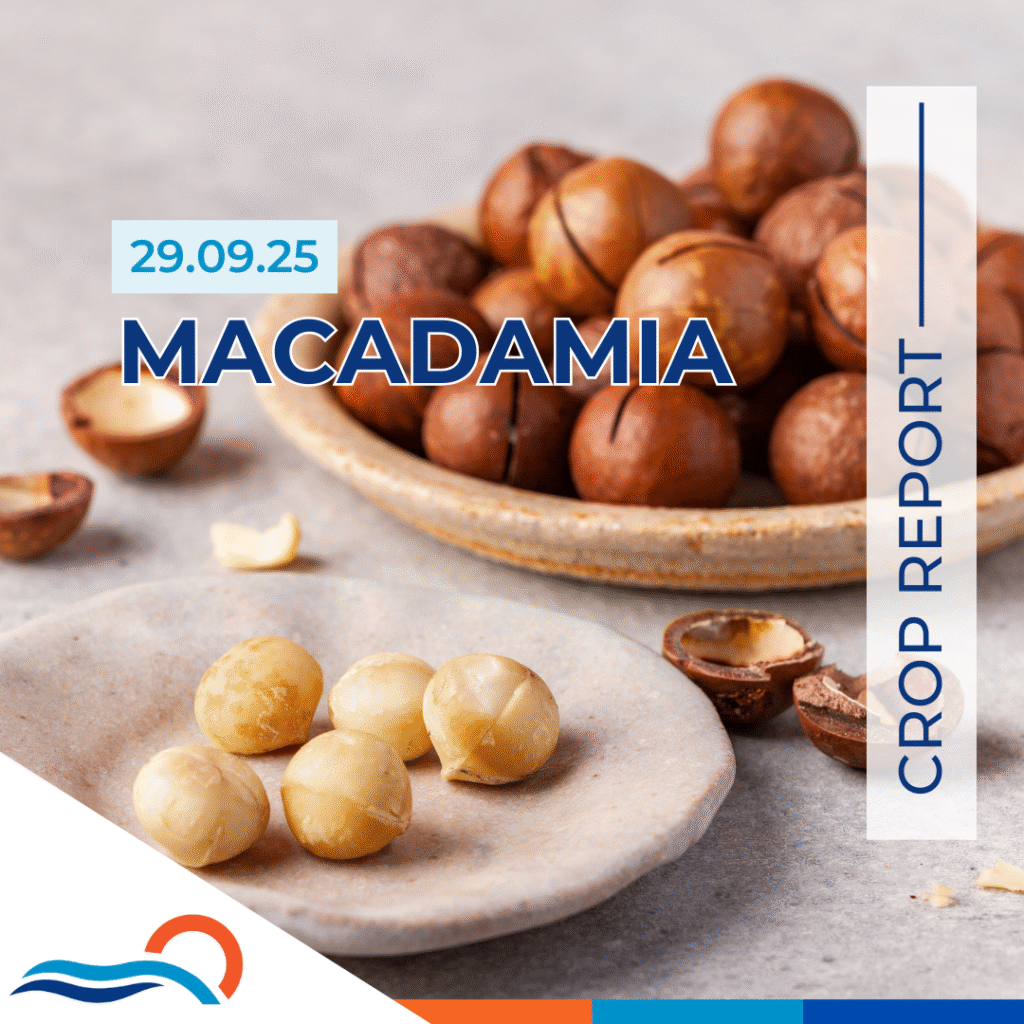
The global macadamia crop continues to show strong long-term growth, with the WMO projecting an annual increase of 7.6%. This projection is based on the steady increase in planted hectares and trees over the past 5 to 7 years, with extensive plantings in both established and emerging origins. Many of these young orchards are now reaching maturity, setting the stage for a rapidly expanding and stabilising supply in the years ahead.
However, 2025 is shaping up to be a challenging year. Yields are underperforming – something that tends to occur every five years or so. Both Australia and South Africa are reporting lower outputs compared to last year.
Since the last update, the Australian Macadamian Society has revised its national crop forecast downward for a second time. This latest adjustment is much more significant than the initial revision in March 2025, which followed Cyclone Alfred. Persistent heavy rainfall along Australia’s East Coast has further disrupted spraying and harvesting. The current forecast is now 37,000 to 41,970 tonnes, a 27–36% year-on-year decline, bringing production back to 2013 levels.
South Africa has also faced difficult growing conditions, including hail and unusual temperature swings, which have impacted yields. Nevertheless, South Africa’s rapid expansion in plantings has helped cushion some of the losses. According to SAMAC, the revised forecast is 85,166 tonnes, about 9% lower than last year.
Supply Projections
Kenya’s main harvest is complete, with solid volumes, and the full season is expected to meet the forecast of 47,500 tonnes. While the declines in Australia and South Africa are notable, emerging origins are helping to balance the global supply. Guatemala is still projected to increase by around 20% year on year to 12,000 tonnes. Smaller but fast-growing producers in East and Central Africa are expected to add several thousand more tonnes.
Overall, the 2025 global macadamia crop is now expected to be about 20,000 tonnes below initial forecasts, representing a decrease of roughly 5%.