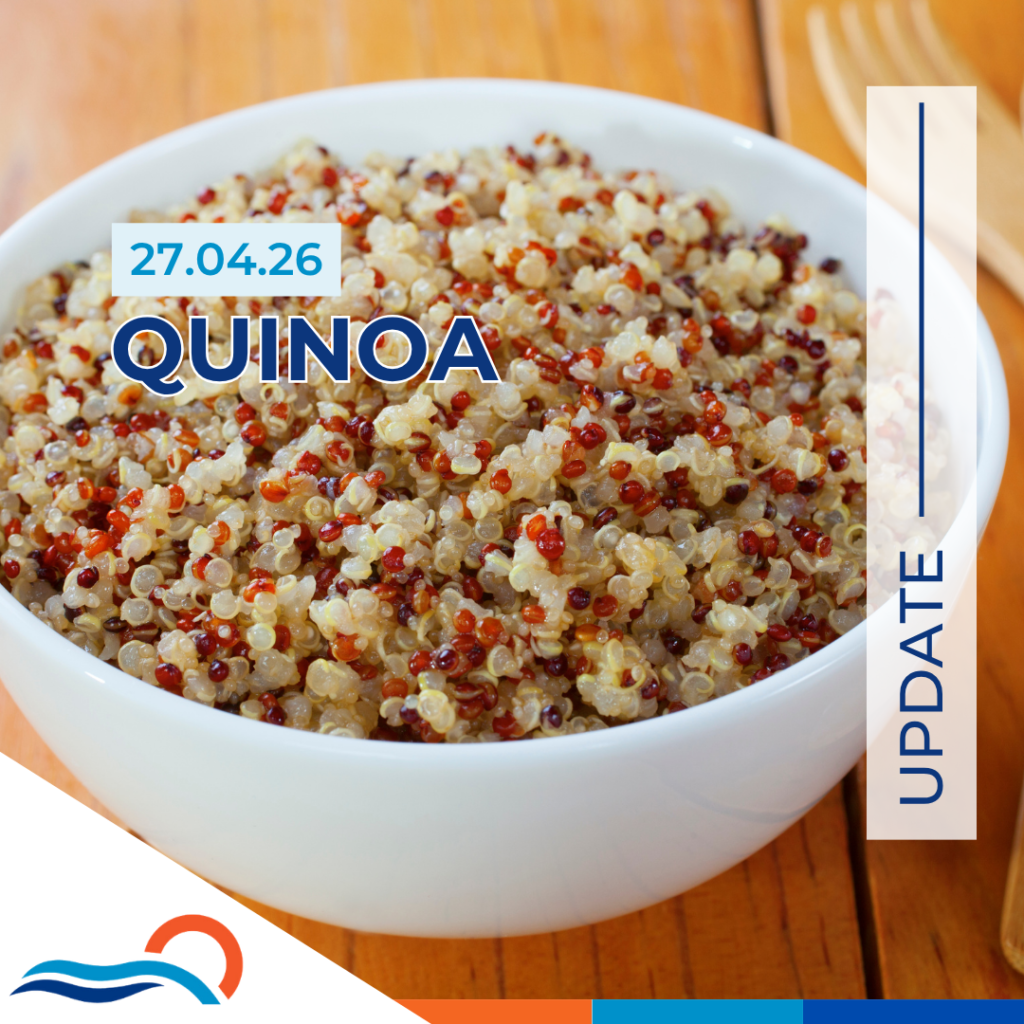
Quinoa Crop Update 27.04.26
Global Quinoa Market Update: Peru and Bolivia (2026)
Peru Quinoa Market Overview
The Peruvian white quinoa market remains well supplied, with healthy volumes available and prices holding stable. In contrast, red and black quinoa from Peru continue to experience limited availability, supporting elevated price levels.
Despite the arrival of the new Peruvian crop, prices for coloured varieties remain high. This reflects lower planting volumes compared to white quinoa, combined with strong global demand following tight supply conditions in the previous season. Black quinoa, in particular, remains the most sensitive segment of the market.
These supply constraints are continuing to place pressure on tricolour blends, where formulation depends directly on the availability of red and black grains.
Crop Development
The 2026 Peruvian quinoa campaign is progressing on an adjusted timeline compared with a normal season. Early‑cycle weather disruptions, including frost events and uneven field conditions, led to changes in planting schedules across several key quinoa‑producing regions.
As a result, while harvest activity is underway, the commercial flow of quinoa is building gradually rather than rapidly. Instead of a strong early‑season availability, export volumes are expected to increase more noticeably during May and June.
From a market perspective, this has created a staggered supply curve, with Peruvian quinoa entering the market progressively rather than in a single concentrated period.
Economic and Political Influence
The quinoa market in Peru has also been influenced by the Peruvian General Elections 2026, which introduced a temporary slowdown in commercial decision‑making across parts of the supply chain. During this period, both buyers and sellers adopted a more cautious approach, resulting in lower short‑term transaction volumes.
As market participants return to normal operating conditions, greater pricing and demand clarity are expected post‑election. Overall, the combination of delayed crop availability and short‑term political uncertainty has reinforced a firm market tone, particularly for high‑specification and organic quinoa programs.
Additionally, ongoing EU regulatory restrictions linked to phosphonic acid and fosetyl residue limits continue to constrain the ability of Peruvian exporters to ship organic quinoa to the European Union, further tightening supply for EU buyers.
Bolivia Market Update
Bolivia Organic Quinoa Availability
Following the 2026 Bolivian harvest, organic quinoa availability remains present, supported by generally good production levels. However, effective market availability is being impacted by reduced volumes passing through formal export channels, as a portion of raw material continues to move through informal trade routes.
Bolivian white quinoa remains the most accessible segment, while red and black quinoa from Bolivia continue to show tighter availability. This reflects a combination of lower planting volumes and strong international demand for coloured quinoa varieties.
Crop Development
The 2026 Bolivian harvest developed under mostly favourable agronomic conditions, delivering solid production outcomes across key growing regions. From a purely production standpoint, the campaign has performed well.
However, the conversion of field production into exportable organic supply continues to be shaped by current market dynamics, including pricing expectations and trade flows.
Market Context
Recent domestic economic developments have added pressure to the Bolivian market. At origin, raw material prices have increased, driven in part by stronger producer pricing expectations. At the same time, informal cross‑border trade continues to reduce product availability within formal export channels.
Additional factors influencing pricing include currency fluctuations, which are affecting cost structures and contributing to ongoing price adjustments. Cost pressure remains evident throughout the value chain, including:
- National inflationary pressures
- Higher field production costs (labour, organic inputs, agricultural practices)
- Increased processing costs (energy, maintenance, labour, certifications)
- Rising fuel prices are impacting domestic transport and export logistics
Outlook
Despite efforts by market participants to maintain price stability in international quinoa markets, current conditions are driving adjustments in FOB prices for organic quinoa. The official release of prices for the new Bolivian organic crop confirms this trend.
Contrary to earlier expectations, prices have not softened. Instead, they are moving higher, reflecting prevailing supply constraints, elevated domestic costs, and producer pricing levels.
Looking ahead, market direction over the coming months will depend on:
- The balance between supply and demand across key global destinations
- The pace of commercial crop flow from origin
- The evolution of domestic cost structures and cross‑border trade activity