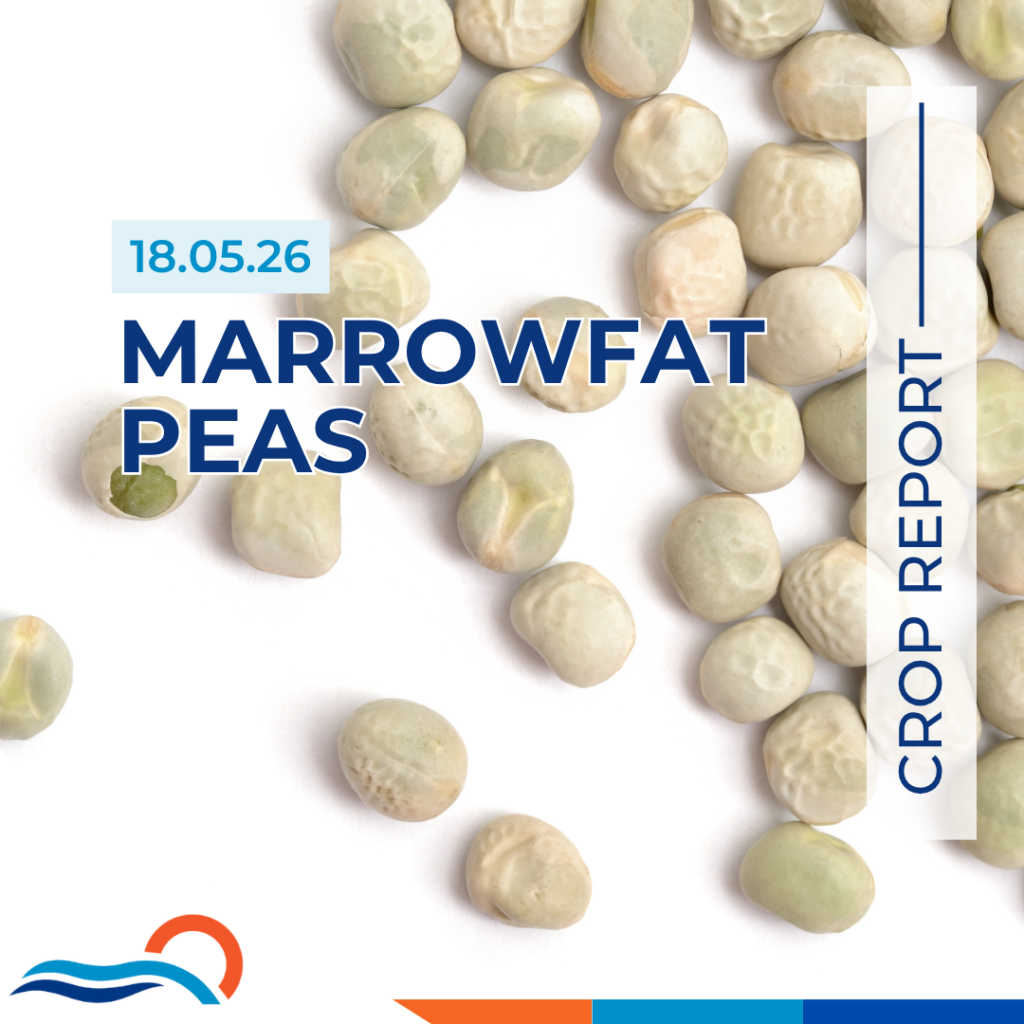
Pea Crop Report 18.05.26
Crop Update 2026
The year began under very favourable weather conditions, providing an encouraging start to the growing season. However, we have now reached a point where rainfall is urgently needed to sustain crop development. The current situation is unfortunately echoing that of 2025, when prolonged dry conditions ultimately led to reduced yields and smaller-than-average pea sizes. That said, it is still relatively early in the season. With timely rainfall, there remains a realistic opportunity for crops to recover and achieve more positive outcomes.
Another parallel with 2025 is the ongoing uncertainty surrounding global trade. As highlighted in last year’s first crop report, unpredictability in international markets continues to present significant challenges across the entire supply chain. From growers to processors and exporters, all participants are affected by fluctuating policies, tariffs, and shifting demand patterns. Greater stability in global markets would not only support profitability across the sector but also reduce exposure to risk, enabling more confident planning and investment.
Marrowfat Peas
The UK 2025 marrowfat pea crop delivered disappointing yields overall, primarily due to adverse growing conditions. Despite this, the majority of the crop has now been successfully marketed, leaving only minimal carryover stocks. This relatively efficient clearance has been supported by strong international demand.
A key driver of this demand has been Canada’s imposition of a 100% trade tariff on exports to China. This has significantly disrupted normal supply routes. As a result, buyers have increasingly turned to the UK to meet their requirements, strengthening export opportunities. Compounding this, New Zealand — another important supplier — experienced a poor harvest due to heavy rainfall during critical harvest periods. These combined factors mean that, while the global market is not severely undersupplied, it remains notably tight, with limited surplus availability.
Over the past twelve months, global grain markets have generally softened. This reflects broader economic pressures and ample supply in some regions. More recently, however, values have begun to firm again, influenced in part by heightened geopolitical tensions and uncertainty. At the same time, reduced profitability in alternative crops has led to a renewed interest among farmers in pea production. This shift has made contract placement considerably easier compared to recent years, with growers more willing to commit to pea acreage as part of their cropping plans.
Overall, while there are clear challenges (particularly around weather and market volatility), there are also positive indicators suggesting opportunities remain for the sector moving forward.